

As Seen On


Turning Complex Code into Clear Learning Paths
The People Behind Every Module
-

Maddox Collins
C++ Syntax Guide Writer
Maddox writes clear notes on variables, operators, and basic code structure. He turns dense C++ topics into calm explanations with practical examples. His work helps learners read syntax with steadier attention and care. -

Callum Porter
C++ Logic Exercise Designer
Callum creates tasks focused on conditions, loops, and program flow. He designs practice sets that connect small ideas through structured steps. His materials guide learners toward careful reasoning during coding practice sessions. -

Brennan Kobel
C++ Function Structure Instructor
Brennan focuses on functions, parameters, return values, and code separation. He explains how smaller code sections can support larger tasks. His lessons encourage learners to organize program parts with thoughtful naming.


Created from Curiosity, Built for Learning


30-days refund guarantee
Choose Your Path Through C++
-
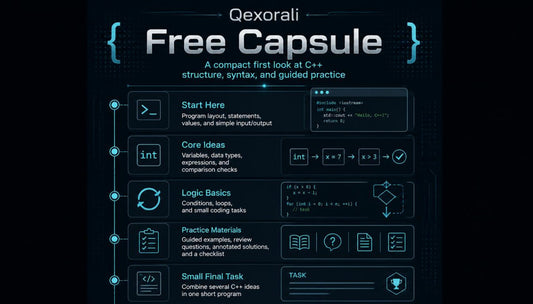
Free Capsule
Regular price €0,00 EURRegular price -
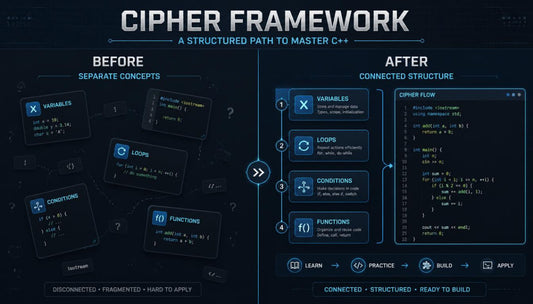
Cipher Framework
Regular price €70,00 EURRegular price -
Drift Pattern
Regular price €118,00 EURRegular price -
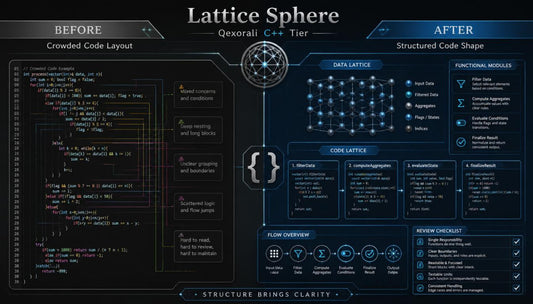
Lattice Sphere
Regular price €173,00 EURRegular price






More Than Syntax on a Screen
-

Guided Flow
Lessons connect C++ ideas through ordered explanations, concise examples, practice prompts, and review tasks.
-

Practical Tasks
Exercises invite learners to write code, trace logic, compare approaches, and review decisions.
-

Code Review
Materials guide learners through naming, structure, repeated logic, and careful revision habits.
-

Steady Practice
Modules support regular study through focused topics, coding briefs, worksheets, and review notes.


Begin with a Complimentary C++ Resource
Discover on All Devices


See What Each Course Holds
Every Line of Code Has a Beginning
-

Nolan Barvis
Nolan came to Qexorali after trying to study C++ through scattered notes and short code samples that did not connect well.
He found the structured module order useful because each topic led naturally into practice tasks and review notes.
“The course helped me slow down, read code more carefully, and understand why each part belongs in the program.” -

Carter Bervard
Carter already knew basic syntax, but he wanted a better way to organize loops, functions, and grouped values in longer tasks.
He found the planning worksheets useful because they showed how to break a written task into smaller coding decisions.
“I liked how the materials made me outline the task first, then write the code with a clearer direction.”


